What if the hardest choices women make are not really choices at all?
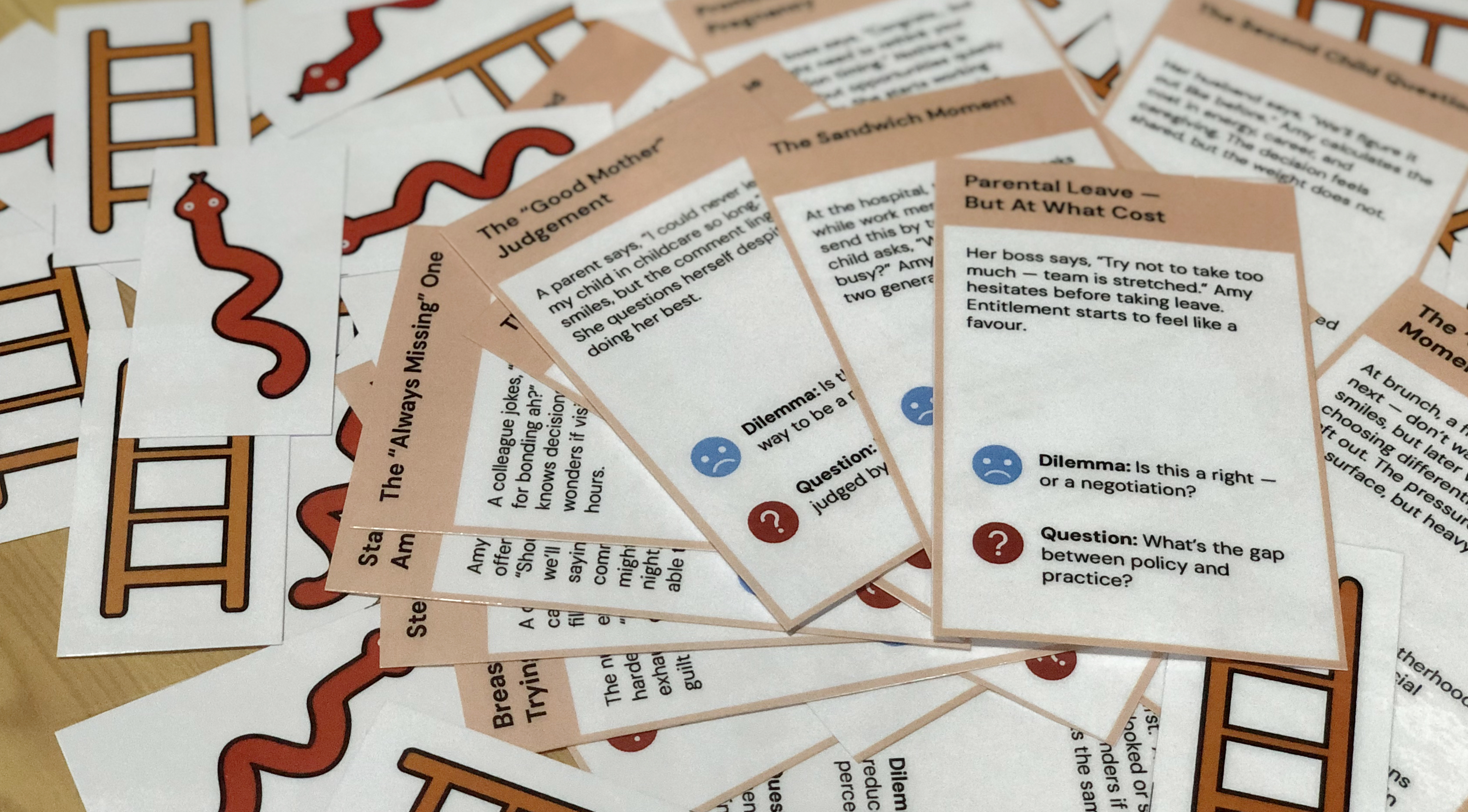
We ran a salon session to surface the hidden barriers women face across life, work, and family. Using a simple snake-and-ladder metaphor, participants stepped into a series of short scenarios, each reflecting a moment of decision – how husbands help, reason for having children, stepping into motherhood, or navigate career and caregiving. As the conversations unfolded, so did the deeper layers behind these choices — the dilemmas, the stories, the fears, and the quiet hopes. What emerged was not just empathy, but a clearer view of the tensions shaping these decisions, many of which are rooted in how our systems are designed.
1 Motherhood is not just a life decision — it is experienced as a loss of control and a risk to identity.
One line came up in different forms across the room:
“It’s your turn, isn’t it?”
It sounds casual, even playful. But behind it sits pressure — from family, from social expectations, from the biological clock. Women are not just making a personal decision; they are responding to a timeline that feels externally set.
What is less visible is what women are actually weighing. It is not just whether they want children. It is whether they are ready to step into a life where control shifts dramatically — over their time, their body, and their daily rhythms. More deeply, it is about identity. The question many are asking quietly is:
“Will I still be myself after this?”
This is where the insight shifts. The hesitation is not about lack of desire for family. It is about the fear of losing control and identity in a way that feels irreversible. Motherhood is not always seen as an addition to life, but as something that could take over it.
The opportunity here is not to persuade women to have children, but to rethink the experience itself. How might we ensure that stepping into motherhood does not feel like stepping out of one’s own life? This requires designing for continuity — of agency, identity, and control — so that motherhood feels like an expansion of life, not a replacement of it.
2 The hardest part is not raising children — it is surviving the first child.
One participant shared candidly:
“We decided to stop at one because we were surprised how difficult it is. Nobody told us that we would have to constantly give our attention to our one and only child.”
This reflects a reality that is rarely made visible. The first child is not simply a transition; it is a shock to the system. Women are simultaneously recovering physically, learning to care for a newborn, and adjusting emotionally — all while being expected to cope and function. The imagined cost of having a child is already high, but the lived experience can be even more overwhelming, and largely invisible until one is in it.
This reframes the problem. The barrier is not just practical — it is physiological, psychological, and social. It is also unevenly distributed, with women carrying the majority of this initial shock.
Interestingly, a contrasting experience emerged. Families with two or more children often described how children begin to interact with each other, play together, and self-manage in small ways. This creates pockets of relief for parents that are absent when there is only one child fully dependent on them.
This reveals a more nuanced insight. The first child is the steepest barrier — a threshold defined by uncertainty and intensity. Subsequent children, while still demanding, are approached with greater familiarity and confidence. However, at that stage, different constraints emerge — financial pressures, housing limitations, and capacity to sustain.
The opportunity here is to move away from treating parenthood as a single decision. Instead, we need to design for threshold-specific support. The first child requires significantly more support, honesty, and recovery. It is less about encouraging entry, and more about ensuring women can survive and stabilise through that initial phase.
3 The system appears to support families — but women are absorbing the cost of making it work.
One participant captured this tension directly:
“The mother guilt, work guilt, colleague guilt, client guilt… it’s very real. I feel torn apart. I can’t meet all end at the same time, and it feels like I have to trade off every day.”
This is not a question of effort or commitment. It is the outcome of navigating multiple systems that are not aligned with each other.
On paper, support exists — parental leave, flexible work arrangements, financial subsidies. But in practice, these come with friction. Leave is available, but difficult to take fully without feeling like a burden. Flexibility is offered, but often translates into being available at all times. Workplaces continue to reward visibility, responsiveness, and uninterrupted trajectories.
At home, responsibilities may be shared, but the mental load — the remembering, planning, and anticipating — often remains uneven. Women are not just managing tasks. They are orchestrating across fragmented systems — work, family, care, and personal life — constantly adjusting to make things function.
This leads to a critical insight. The issue is not the absence of support. It is that support is costly to use, and the cost is absorbed by women in the form of guilt, exhaustion, and trade-offs.
The opportunity here is not to add more benefits, but to remove friction. This means redesigning how systems work together — aligning policy, workplace expectations, and lived realities — so that women are not the ones bridging the gaps. It is about shifting from individual coping to systemic coherence.
Closing Reflection
Across all three tensions, a deeper pattern emerges.
Women are not simply navigating life choices. They are navigating conditions that shape what those choices feel like — whether they feel possible, sustainable, or worth stepping into.
What we call “choice” is often structured long before the decision is made.
If we want women to thrive across family, career, and life, the question is not only how to support them better. It is whether the systems we have designed today are enabling them to live fully — or requiring them to constantly trade off parts of themselves just to make it work.
—
If you are working in this space or are interested in exploring how we might better support women across life, work, and ageing, we would love to connect.
Our team is actively contributing to research and facilitating co-design engagements to uncover meaningful, system-level opportunities for change.
Get in touch with us at info@thinkplace.com.sg to explore partnership opportunities.